
In April 2025, tragedy struck when Victor Perez, a 17-year-old autistic and nonverbal teenager with cerebral palsy, was shot multiple times by Idaho police while standing behind a chain-link fence. Despite several surgeries, including the removal of nine bullets and the amputation of his leg, Victor passed away after being removed from life support. His death sparked outrage among his family and the local community, raising urgent questions about how individuals with disabilities are perceived and treated in crisis situations.
Unfortunately, this is not an isolated case. People with disabilities, autism and other neurodiverse conditions face systemic discrimination and poor treatment across the healthcare and emergency response systems. According to the World Health Organization, they are three times more likely to be denied healthcare and four times more likely to be treated poorly within the healthcare system. These inequities often begin at the very first point of crisis,through interactions with police, EMS, or fire services, and persist throughout their care in hospitals and clinics.
A critical factor driving these disparities is the lack of structured training and awareness among first responders and healthcare professionals on how to effectively support individuals with disabilities. Too often, professionals encounter individuals with autism, neurodiversity or other disabilities without having the tools to interpret behaviors, adjust communication or apply de-escalation methods. This gap in training not only places patients at risk of harm, but also leaves providers feeling unprepared and unsupported when faced with complex situations.
To address this urgent need, we developed a comprehensive, evidence-informed training program on autism, neurodiversity and disability awareness. The program is designed to bridge the knowledge gap and equip participants with practical, transferrable skills that can be applied immediately in both clinical and emergency response settings. The curriculum emphasizes the following core areas:
- Understanding Neurodiversity and Autism: Participants gain a foundational understanding of autism spectrum disorder, neurodivergent conditions, and common co-occurring disabilities. The training explores how sensory sensitivities, communication differences and behavioral expressions may present in medical and crisis situations, helping professionals distinguish between medical emergencies, behavioral responses and signs of distress.
- Recognizing Signs and Communicating Effectively: The course provides practical tools for identifying early indicators of escalation and distress. Participants learn both verbal and nonverbal communication strategies tailored to neurodiverse patients and their families, including the use of plain language, visual aids, patient-centered listening and body language awareness. Emphasis is placed on building trust and reducing patient anxiety during high-stress encounters.
- De-escalation Techniques Rooted in Safety and Respect: The program emphasizes nonviolent crisis intervention and scenario-based de-escalation. Participants practice calming strategies such as sensory accommodations, tone modulation, physical positioning and time/space adjustments. These techniques ensure that safety is maintained without compromising dignity, autonomy or patient rights.
- Collaborative, Team-Based Care: Trainees learn to coordinate across disciplines—EMS, law enforcement, nurses, physicians, and allied health providers—so that care is consistent, respectful and patient centered. The curriculum reinforces the importance of role clarity, clear communication and collective problem solving in managing complex cases.
- Legal, Ethical and Case-Based Learning: Participants engage with real-world case studies and simulations to apply what they have learned. They are introduced to relevant disability rights laws, standards of care and ethical frameworks that guide decision making. By working through practical scenarios in groups, participants build both confidence and competence in addressing the unique needs of patients with autism and disabilities.
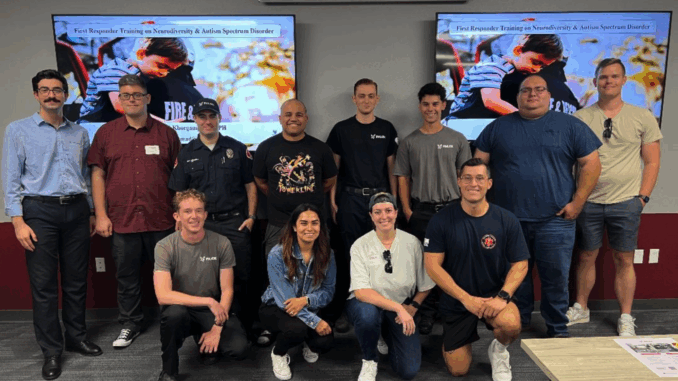
The program was first piloted at the UCLA Center for Prehospital Care, where it was integrated into continuing education for EMS professionals and other first responders. Early sessions received enormous positive feedback, with participants consistently reporting that the training filled a critical gap in their professional preparation. Recognizing its impact, the program was subsequently reviewed and awarded CAPCE accreditation, allowing it to be formally recognized for continuing education credits. This accreditation significantly broadened its reach, enabling fire departments, ambulance services and law enforcement agencies across California to have access to the training as part of their professional development.
Evaluation data underscored the program’s effectiveness. Participants completed pre- and post-training assessments measuring both knowledge and confidence in working with autistic and neurodiverse individuals. Results showed a marked improvement: confidence scores rose from 4.8 before the course to 8.2 afterward, on a 10-point scale. In addition, qualitative feedback highlighted not only increased competence but also a greater sense of empathy, patience and readiness to provide respectful care. Many participants reported that the training gave them tools they wished they had earlier in their careers and expressed that it should be mandatory across all emergency and healthcare systems.
Building on this success, the program expanded to Midwestern University’s Arizona College of Osteopathic Medicine, where our next goal is to integrate the training across multiple healthcare disciplines. Medical, nursing and dental students now participate alongside practicing clinicians, creating valuable opportunities for cross-disciplinary learning and collaboration. By introducing this training at the formative stage of professional education, the program ensures that future physicians, nurses, dentists, and allied health providers enter their careers equipped with the knowledge, cultural awareness and empathy needed to serve diverse patient populations.



Be the first to comment