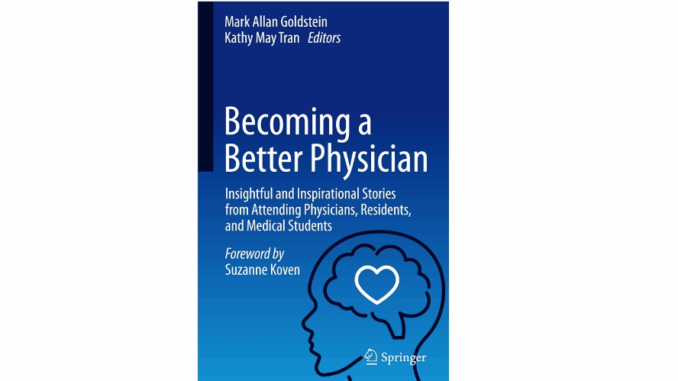

Becoming a Better Physician is not a manual, a checklist, or a guide to clinical mastery. Instead, it is a carefully curated collection of personal reflections that asks a more fundamental and enduring question: what does it actually mean to become—and remain—a better physician? Edited by Mark Allan Goldstein, a longtime pediatrician, adolescent medicine physician, educator, and author, and Kathy May Tran, a general internist, medical educator, and nationally recognized leader in narrative medicine and storytelling, the book brings together essays from attending physicians, residents, medical students, and retired clinicians. Each contributor offers an honest account of a personal or professional challenge and reflects on how that experience shaped them, not only as clinicians, but as human beings practicing medicine.
The book is organized into six thematic sections: Learning and Training, Career, Caregiving, Physician as Patient, Personal Growth, and Love and Loss. Each section is introduced by a brief commentary and followed by deeply personal narratives. Together, these sections trace the arc of medical formation itself: early idealism, ethical tension, emotional labor, illness and vulnerability, identity formation, and, ultimately, encounters with loss. By arranging the essays in this way, Becoming a Better Physician invites readers to move through medicine as it is actually lived. Layered, nonlinear, and shaped as much by experience as by expertise. Rather than framing these moments as obstacles to overcome on the path to competence, the book treats them as essential teachers in the lifelong process of becoming a physician.
It is within this framework that the book’s humanity comes most fully into view. Across its essays, Becoming a Better Physician gives voice to emotional realities of medicine that are often minimized or left unnamed: the fragility of professional identity, the burden of invisible illness, and the quiet accumulation of grief. In “Being Fired,” Michael Jellinek, MD, a senior academic psychiatrist and former health system executive, recounts the shock and disorientation of being abruptly dismissed after nearly four decades of leadership and institutional service, capturing the profound loss of identity and belonging that can follow professional rupture. That loss is ultimately reframed through the deeper, more enduring grief of losing a child, offering a perspective shaped by humility, love, and hard-won clarity. Similarly, in “Doctors Are Humans: Breaking Painful Stereotypes,” Giuseppina Romano-Clarke, MD, a pediatrician and medical educator, reflects on navigating medical training and practice while living with multiple sclerosis, exposing the fear, self-doubt, and pressure to conform to an idealized image of the invulnerable physician. Together, these essays reveal a form of humanity grounded not in perfection or endurance alone, but in honesty, limitation, and self-compassion. The book makes space for physicians to be fully human, and in doing so, suggests that such humanity is not a liability, but a necessary foundation for meaningful medical practice.
What makes Becoming a Better Physician especially powerful is not only what these stories reveal, but what they ask readers to do in response. The essays invite deep self-reflection and an examination of the limits, values, and conditions necessary to sustain a life in medicine. That invitation resonated deeply with me as someone navigating medical training through an MD/PhD pathway. In “The Night I Almost Walked Away from Medicine,” Shan W. Liu, MD captures a moment of clinical chaos and moral injury familiar to many trainees, when exhaustion, system failure, and a charge of “unprofessionalism” nearly push her out of medicine altogether. What lingers most from her essay is not the breaking point itself, but the clarity that follows: the recognition that kindness, sustainability, and self-care are not ancillary to good doctoring, but essential to it. Reading this essay forced me to reflect honestly on my own limits and on how caring for others must be accompanied by caring for oneself if one hopes to remain in this profession.
That reflection deepened further in “unDOCumented Medicine,” in which Felippe O. Marcondes, MD writes about pursuing medicine as an undocumented immigrant while carrying academic excellence alongside persistent uncertainty, fear, and moral distress. His story struck me profoundly. As an immigrant from Colombia, I spent many years believing that a career in medicine might remain out of reach. Not because of ability or dedication, but because of legal status, residency barriers, and a pervasive sense of not belonging. Dr. Marcondes’ essay brought those memories to the surface, reminding me how deeply immigration status can shape one’s medical journey and how invisible those struggles often remain. More importantly, his story reframed possibility. It did more than inspire me to continue pursuing medicine. It strengthened my resolve to become a future role model for trainees who may be walking similarly uncertain paths.
This book matters now because it answers the question it poses at the outset: what does it actually mean to become—and remain—a better physician? It does so not through instruction or mastery, but through reflection on what it takes to remain human in a profession under increasing strain. Medicine is practiced today amid mounting pressure on individuals, systems, and the ideals that draw people to this work in the first place. Becoming a Better Physician offers a timely reminder that competence alone is not enough to sustain a meaningful life in medicine. At a time when efficiency, productivity, and resilience are too often emphasized at the expense of reflection and care, this collection makes a quiet but urgent case for something deeper: that becoming a better physician is inseparable from becoming a more attentive, compassionate, and self-aware human being.
The courage of its contributors (medical students, residents, and physicians at every stage) lies not only in the stories they share, but in their willingness to be seen in moments of uncertainty, grief, failure, and growth. This is a book for premedical students wondering what lies ahead, for trainees searching for permission to feel and reflect, for early-career physicians finding their footing, and for seasoned clinicians and educators seeking renewal and meaning in the work they continue to do. Ultimately, Becoming a Better Physician is an invitation into community, into reflection, and into a shared commitment to doctoring that honors both competence and humanity. It reminds us that none of us become better physicians alone, and that telling, and listening to, these stories is itself an act of care.