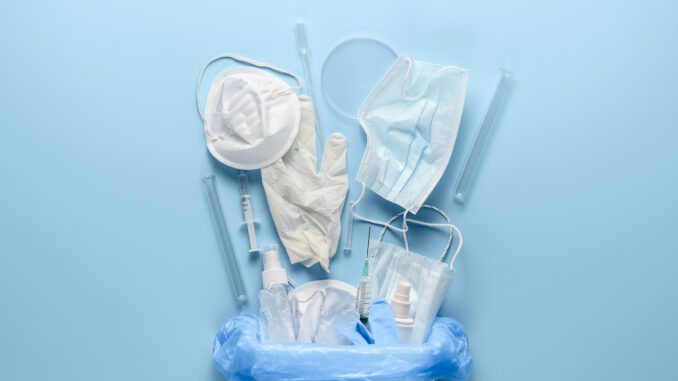

I recall the first time I saw a laryngoscope blade, clean, intact and in excellent condition, being discarded in the garbage can. It was not contaminated. Not broken. Simply “expired” and marked obsolete by a date printed on the plastic packaging, which would last much longer than the metal ever would. I was standing in the supply room, holding my morning coffee, and thinking of the nursing student I had mentored the previous week, bright and focused, practicing her skills on a discarded mannequin using equipment so old that some of the parts barely fit any longer. The cognitive dissonance was quick and unpleasant. We were discarding what someone else desperately needed. That was not a radicalizing moment, but it unsettled me. And perhaps that disturbance, that discomfort, is precisely what the University of Washington’s study on medical humanities is actually directing when it is discussing empathy.
Empathy in medicine is generally intended to refer to the patient-provider relationship, as argued by Graham et al. (2016). To hear beyond the chief complaint. To perceive the individual, not only the pathology. I began to wonder whether empathy could extend beyond individual encounters. What about compassion towards systems? To the student three states away who cannot afford to fail their skills check because they have never used real equipment? MedCycle Connect was created because I could no longer ignore the pattern. Each cancelled surgery results in supplies prepared and discarded. Each expired box represented years to months of training value wasted in a landfill. A study by Lee and Lee (2022) found that expired medical supplies not in contact with patients are often unnecessarily discarded as infectious waste, increasing healthcare’s environmental burden when these materials could serve educational purposes. And each time I talked to an educator who was not able to expand the budget, the refrain was the same: “We make do.” The medical humanities teach us to interpret stories, sit with ambiguity, and put ourselves in others’ positions. I did not anticipate that the same interpretive skills would apply to reading a medical waste story.
University of Washington research shows that reading literary fiction improves theory of mind, which involves the ability to understand others’ thoughts. I would also say that reading stories instructs us to consider where others see the end. Every good story asks “what if?” In medicine, we are conditioned to consider expiration dates as the end. Supplies expire. Story over. Dispose of and move on. But narrative thinking asks: What is the next chapter? A suture kit that has expired cannot be used to seal a patient’s incision, but it can instruct a medical assistant student on how to first open a sterile field. An expired IV start kit cannot be used to insert a vein, but it can provide the confidence an EMT student needs through repetition, muscle memory, and hands-on practice before disaster strikes. As study by Leiphrakpam et al. (2024) note in their review of simulation-based medical education, old and expired medical equipment from healthcare facilities can be effectively reused in training environments, offering practical workarounds to the cost and access barriers that limit simulation adoption. This isn’t recycling. It is refusing to let value disappear the moment an object no longer serves its original purpose. Such an imagination, such a non-conformity to the default narrative, is deeply familiar to the interpretive labor of the humanities.
The University of Washington research notes one of these issues: the hardening of the heart, which occurs during medical training. Students come in with compassion and idealism, and at some point in the process, usually in the clinical years, that tenderness is solidified into cynicism or disengagement. I no longer think of that hardening in the same way. It may not necessarily involve losing empathy for patients. Possibly, it is the loss of sympathy towards possibility. We become efficient. We learn the protocols. We do not ask the systems questions because it is too tiring and the system is too large, and we still have patients to attend to. The laryngoscope blade is discarded in the trash, as we do with expired supplies. We don’t pause. We don’t ask “what if?” The idea of starting MedCycle Connect made me stop. To question. To remain uneasy with wastage, injustice, and disparity between what we dispose of and what others require. And this is where my surprise set in: That unease did not weigh me down. It energized me.
I have interviewed dozens of teachers and learners who have received donations from MedCycle Connect. What is so striking is not so much their thankfulness, but their relief. Relief that they can practice without the fear of having to waste costly supplies. Relief on the fact that they can make mistakes in a low-stakes environment. Comfort that somebody noticed their plight and went out to help them, not with judgment but resources. One nurse educator informed me that her students can now practice wound management techniques repeatedly, open dressing packets, compare products, and develop the feel of use that turns book knowledge into practical skills. You allowed us to allow them to fail, she said. And practice not perfected is not perfected with patients. That was the point that made it clear to me. Empathy is not merely a matter of emotional sensitivity. As per the study by Graham, it is the establishment of a setting in which other people can grow, make errors, and develop competence without embarrassment or insufficiency.
I am in rural New Mexico, where being resourceful is not a choice but a survival strategy. We improvise. We collaborate. We allocate resources and distribute equipment, as isolation requires it. I have learned, however, to appreciate resourcefulness in the country as more than pragmatism. It is a kind of protest against the scarcity mindset that runs through healthcare. Medical humanities are also resistant. They oppose reducing patients to pathology. They oppose the notion that efficiency is the highest value. By diverting spoiled supplies to training programs, I am challenging the narrative that waste can never be overcome, that education should make do with less, and that rural providers can never be the change agents in the country.
This is what the medical humanities have taught me: empathy is not a skill, but a practice. You develop it with multiple events of attention, interpretation, and imagination. Research demonstrates that this practice is significant Graham et al. (2016) showed that medical humanities coursework correlates with greater empathy in medical students, and more recently, research by Srinivasan et al. (2024) found that empathy and cultural competence remained stable throughout medical school in programs prioritizing humanities education, suggesting that students who receive a humanities education do not lose empathy under conditions designed to destroy it. It is the humanities that teach us to continue seeing. To look beyond the diagnosis and see the patient. The probability of the expiration date. Such a vision needs practice and systems that allow space to contemplate systems designed to be fast. My effort to put those lessons into practice is MedCycle Connect, to be curious about waste, and to show students that empathy is not what you feel about patients, but how you view the entire system.